
The September Garden: What I’m Harvesting, Sowing and Preserving
Updated: 9 hours ago
By September, the garden has stopped trying to impress anybody.
The sunflowers are collapsing under their own weight. Some plants are yellowing. Things that looked beautifully deliberate in June are now leaning on one another like drunk people at closing time. There are jobs everywhere, several of which I have mentally filed under Andy Will Need To Deal With That Eventually.
And yet I can still go outside with a basket and come back with dinner.
Tired does not mean finished
This is the bit of the growing year I used to underestimate. The garden looks as though it is winding down long before it actually stops being useful.
There are tomatoes, runner beans, peppers, herbs and greenhouse aubergines. Flowers are still going. The chickens are still investigating anything I would prefer them not to investigate. A warm afternoon can still feel completely like summer even though I need a jumper by evening.
September is less about starting things and more about paying attention to what is still happening.
Not everything worked
The courgettes were rubbish this year. I know courgettes are supposed to be the vegetable you accidentally grow seventeen of and start leaving on neighbours' doorsteps, but mine apparently missed the briefing.

Outdoor aubergines were similarly unimpressive: one fruit is not exactly an agricultural triumph. The greenhouse plants did better, which is useful information for next year rather than a personal insult from an aubergine.
This is why I take notes while the season is still fresh. By January I will remember the good tomato and completely forget the six weeks I spent complaining about something else.
The tomatoes have earned their space
Next year I already know I want two beds of tomatoes. I am not bothering with Romas again. Pineapple and Old German are the sort of tomatoes that remind me why I grow tomatoes rather than simply buying perfectly respectable ones from a shop.
That is increasingly how I judge a crop: not just yield, but whether the home-grown version earns the space and effort. A tomato that tastes extraordinary gets a much easier route back into the garden than something prolific but forgettable.
The garden is feeding the larder now
At this point harvesting and preserving become the same job viewed from opposite doors.
Basil is being dried. Tomato, garlic and basil compound butter is in the freezer. Aubergines have been roasted and frozen. Peppers and jalapeños have become relish and cowboy candy. Runner beans are appearing faster than I can pretend to be surprised by them.
This is where the garden starts making winter food rather than simply summer dinners.

I am already planning next year, obviously
There is something faintly ridiculous about standing in a garden that is still producing while mentally rearranging it for a year that has not happened yet, but this is exactly when I make the best decisions.
I know which beds annoyed me. I know what sprawled into a path, what needed more support, what I wished I had planted twice as much of and what I am only growing again if it submits a written apology.
The plan currently includes two onion beds and two tomato beds. There will be arches. There will be changes. There will undoubtedly be something I become obsessed with over winter and squeeze in despite claiming the plan is final.
There is still time to sit down
One thing I do not want to lose as the productive garden expands is the fact that it is also somewhere we live.
I do not want a garden I only visit to work. I want to pick beans and then sit down. I want flowers mixed through the food. I want the lights on in the evening. I want chickens wandering about being unhelpful. I want to notice the sunset rather than only the jobs.
September is particularly good for that because the frantic growth has eased enough to see the garden again. Not the idealised version. The actual one: tired, useful, a bit wild and still feeding us.
There will be plenty of time for clearing. For now I am taking the beans inside.
What happens to the harvest once it comes inside
September is the month when the garden stops politely existing outside and starts occupying the kitchen.
There are tomatoes on the counter. Beans in a basket. Herbs that need drying. Peppers waiting for a decision. An aubergine I am emotionally committed to using before it goes soft. None of it arrives in one beautiful harvest photograph with a convenient free afternoon attached.
It comes in waves, and the real skill is not preserving everything. It is noticing what needs dealing with first.
Basil: deal with it immediately
Basil is one of those crops that can go from glorious to tragic while I am still congratulating myself on picking it. Some has gone into the dehydrator. Some has gone into compound butter with tomato and garlic, portioned and frozen so Future Gemma can make something taste like September with almost no effort.
This is the kind of preserving I use most: not a heroic pantry full of identical jars, but small useful shortcuts that make dinner easier.
Aubergines: roast first, decide later
The outdoor aubergines have not exactly covered themselves in glory this year. The greenhouse has done better. What I do get, I am happy to roast and freeze rather than forcing myself to invent an aubergine-heavy week because the plant has finally produced something.
I have also made aubergine pesto for the freezer. Frozen in useful portions, it becomes pasta sauce or the beginning of something else instead of a vegetable glaring at me from the fridge.
Peppers: this is where things get more interesting
The jalapeños and red peppers have already become cowboy candy and pepper relish. This is the sort of preserving project I genuinely enjoy: something we will actually eat, made from a glut while the ingredients are right there.
I am not interested in preserving for the sake of being able to say I preserved it. If nobody wants to eat twelve jars of something in February, I have merely turned fresh produce into a storage problem.
Tomatoes are allowed several careers
Tomatoes are the crop most likely to trigger the illusion that I should have one grand plan. I do not. Some get eaten immediately. Some go into sauces. Some end up with garlic and basil. Some become freezer cubes or components for future pasta. Some are simply sliced onto whatever I am eating because that is what a tomato is for.
I would rather preserve them in forms that match how we cook than spend a day producing jars that look impressive and then sit untouched.
Beans: there are always more beans
Runner beans are excellent at making you feel briefly competent and then punishing that confidence with another basket.
Some get eaten fresh. Some are frozen. Some wait a day longer than they ideally should because I am a person with a job and a house and apparently other interests beyond processing legumes.

That is another thing I am trying to get better at: not treating a productive garden as a moral test. A bean is not disappointed in me if I fail to optimise its destiny.
The freezer is doing a lot of the heavy lifting
At this point the freezer contains the evidence of several seasons: chicken stock, onion gravy, caramelised onions, bolognese, pesto cubes, summer pasta sauce, sugar snaps, runner beans, garlic, edamame and whatever else I have tucked into a gap and will rediscover with delight or confusion later.
I like freezing because it is forgiving. It lets me preserve components rather than complete meals. A cube of pesto or a portion of sauce can become whatever dinner needs to be that day.
The goal is not maximum preservation
There is a particular fantasy of the productive garden where every harvest is transformed, labelled and stored with military efficiency. Mine is not like that.
Some things are eaten standing at the counter. Some become dinner. Some go into jars. Some go into the freezer. Some get forgotten until they are beyond saving. I am trying to reduce the last category, not pretend it does not exist.
For me, preserving works when it extends the usefulness of the garden without turning the garden into another employer.
September is busy enough. I want February pasta that tastes of basil, a jar of pepper relish with something salty, frozen beans for dinner and the satisfaction of knowing that at least some of this ridiculous abundance followed us into winter.
The rest can be eaten now. Preferably before Andy finds it.
What I’m still sowing in September
September is when gardening advice starts talking as though the year is over. Clear the beds. Put the tools away. Start planning next year. And yes, there is a little of that happening here - but my garden is very much still alive.
Down here on the south coast, autumn tends to arrive politely. We can stay surprisingly mild well into October and sometimes November, which means September is less an ending than a change of gear. The tomatoes are still coming, the beans are still producing, and there is absolutely time to get a few things started for the cooler months.
Spinach is the obvious one
Spinach is one of the easiest wins at this time of year. It much prefers the cooler weather to midsummer heat, and I already have a patch that behaves almost like a perennial for me. I’ll still scatter more seed into gaps, though. I’m not aiming for military rows; I just want leaves coming through as the garden slows down.

Coriander and parsley can do their own thing
Coriander is another herb I’d rather grow in the cooler months. It bolts too quickly when it is hot, so September is a much nicer time to sow it here. Parsley is even less demanding. Mine has become very good at self-seeding, which is exactly the sort of gardening arrangement I approve of: I provide a patch of soil and occasional encouragement; it takes care of the rest.
The brassicas are getting a second chance
I’m also re-sowing some cabbage, pak choi, cauliflower and broccoli. Not because the first attempts were glorious. Quite the opposite. Slugs treated several of my earlier sowings as a complimentary buffet.
But that is the advantage of a long autumn: I can try again. Cooler, damper weather is not automatically slug-free, obviously, so these need more protection than my optimistic first round received. I’m also not trying to fill every bed with them. A few successful plants are much more useful than a grand plan that ends up feeding wildlife.

What I’m not bothering with now
I’m not forcing summer crops into a September sowing just because I have empty compost and packets of seed. Courgettes have already tested my patience this year, and I don’t need a heroic late sowing to prove a point. Tomatoes, aubergines and the rest can stay firmly in the category of crops I’ll plan properly for next year.
I garden by the weather more than the calendar
The biggest lesson I’ve learned is that generic monthly gardening lists are only ever a starting point. My first proper frosts are usually much later than the dates quoted for half the country, so there is no sense behaving as though the beds are about to freeze solid because the calendar says September.
I watch the light, the night temperatures and the actual plants in front of me. If the soil is warm and something has time to establish, I’ll sow it. If the garden is telling me it has had enough, I’ll stop. September is a lovely month for that sort of gardening: less frantic than spring, but nowhere near finished.
A dehydrator day: herbs for the winter pantry
There are preserving days that involve boiling water, stacks of jars and the kitchen looking like a small industrial unit. And then there are dehydrator days, which are much more my speed when the garden is still producing faster than I can keep up with it.
At the moment it is herbs. Basil first, parsley next. They are exactly the sort of harvest that feels insignificant when you cut it and ridiculously valuable in January when every supermarket bunch looks tired and costs more than it should.
The part that matters most is getting them properly dry
I pick through the herbs, remove anything damaged and wash them if they need it. Then I make sure they are genuinely dry on the surface before they go anywhere near the dehydrator. Starting with soaking-wet herbs only makes the whole process take longer.
I spread the leaves out rather than piling them up and let the dehydrator do the boring work. I’m looking for leaves that feel completely dry and crumble easily rather than anything leathery or bendy.
I leave them whole until I need them
I prefer to store dried herbs fairly whole instead of crushing them straight away. They keep more of their character that way, and I can rub them between my fingers as I use them. It also stops every jar turning into green dust by Christmas.
Cool first, jar second
Once the herbs are dry, I let them cool before putting them into clean, dry jars. Warm dried food sealed immediately can create condensation, which is exactly what I do not want. For the first few days I keep an eye on the jars too. If I ever saw moisture forming, the herbs would go straight back into the dehydrator.
Why I bother when dried herbs are cheap
Because these are my herbs. I grew them, cut them at their best and know how fresh they were when they went in. The flavour is better, but there is also something deeply satisfying about opening a jar in February and recognising September immediately.
That is what I like most about this kind of preserving. It is not dramatic. It is just quietly moving part of one season into another.
How I freeze aubergines so they’re actually useful later
Aubergines are one of those vegetables that can go from “lovely harvest” to “why do I suddenly own seven of these?” surprisingly quickly. I like them, but I don’t always want to build dinner around them on the exact day they are ready.
My solution is not to freeze them raw. I roast them first, remove the skins and freeze the cooked flesh in useful portions. It is not a method for preserving neat slices or anything you want to fry later. It is a method for preserving flavour and giving future me a shortcut.
Why I cook them first
Raw aubergine is mostly structure and water. Once frozen and thawed, that structure is never going to behave quite like a fresh aubergine. Rather than fight that, I cook them until soft first and preserve the part I actually want: the silky flesh.
My basic method
I roast the aubergines until they are completely soft and collapsing. Depending on their size, I’ll roast them whole or cut them in half first. Once they are cool enough to handle, I peel away the skins and let the flesh sit for a little while so any obvious excess liquid can drain off.
Then I portion the flesh into freezer containers or bags in amounts that make sense for one meal. I flatten bags where I can because they freeze quickly, thaw quickly and stack much more politely than a collection of mysterious frozen lumps.
Label it properly
This is the boring bit that saves the whole system: write what it is and when it went into the freezer. “Roasted aubergine - September” is infinitely more helpful in January than trying to identify a brownish frozen rectangle by vibes alone.
What I use it for
The thawed aubergine works beautifully anywhere I want soft texture rather than defined pieces. I can stir it into tomato-based pasta sauces, add it to soups and stews, blend it into dips, fold it into a vegetable bake or use it as the base of something garlicky and savoury on toast or flatbread.
It is especially useful on the sort of winter evening when I want dinner to taste as though I made an effort without actually making much of one.
What I don’t expect from it
I would not thaw this and expect it to become crisp fried aubergine or neat slices for a dish where texture is the point. Freezing always changes things. The trick is to preserve ingredients in the form you are most likely to use later, rather than trying to force them to pretend they are fresh.
For me, roasted aubergine earns its freezer space because it turns a September glut into a winter ingredient I will genuinely reach for. That is the standard I’m trying to apply to preserving in general: not “can I save this?” but “will I actually be pleased to find this later?”
September in the Potager: What I’m Sowing, Planting & Harvesting
WORKING DRAFT — recurring monthly Potager diary for September. Pull together the actual sowing, planting and harvest picture in one place, with links to the existing September garden, sowing and harvest/preserving posts rather than duplicating them. Include what is still producing, what I’m clearing, what is being sown for autumn/winter, what worked, what failed and what I’m already thinking about for next year.
What this month looks like here

September is not the end of the growing year here. The garden is still producing, the weather can stay surprisingly kind and there is plenty of life left in the beds even while autumn starts creeping in around the edges.
That overlap is one of my favourite parts of the year: harvesting summer crops while sowing for cooler weather, clearing one patch while another is still going, and trying to remember that “seasonal” rarely means everything changes on the first of the month.
Late Summer Abundance
There’s a particular kind of magic in the garden at this time of year. Everything feels a little wilder, a little messier, and a lot more generous. The structure is still there — the paths, the beds, the pergola — but September softens all the edges and lets the plants do what they do best: take over.
Here’s a little wander around, through today’s end-of-summer chaos…
Grapes on the pergola

The grape pergola is heavy with fruit this year. Deep purple bunches hang beneath the leaves, almost too good to be true, while the whole thing has become a shady little ceiling of late-summer abundance.
Hops taking over

On the other side, the hops have well and truly claimed the pergola, with clusters of green cones spilling over the beams. Fruit, flowers and hops are all tangled together now — a very September sort of order.
Sunflowers and a surprise

The sunflowers are still going, even as they turn to seed. Tucked amongst them, a pumpkin is quietly developing — an unexpected and very welcome guest.
The strawberry tower

The strawberry tower is still producing, surrounded by a jungle of sunflowers and late-summer growth. At this point the paths are less boundaries and more polite suggestions.
A wilder garden
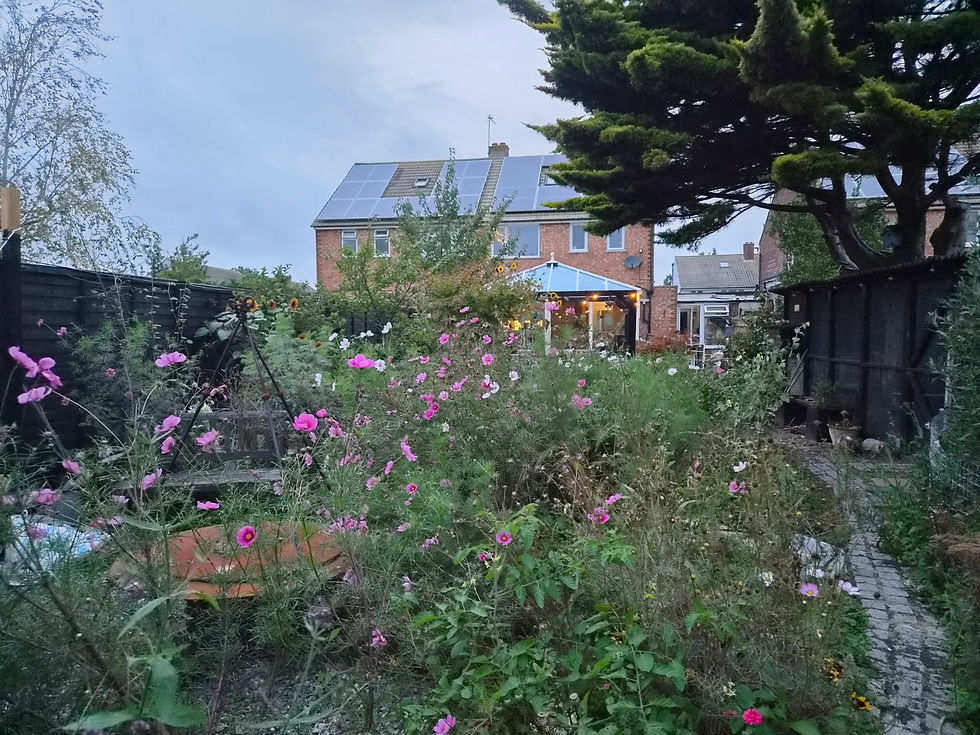
From the bottom of the garden, it’s clear just how much life there is right now. The cosmos are in full swing, the beds are spilling over, and the house almost disappears behind a sea of colour and texture.
It might be a bit chaotic, but it’s the good kind — the kind that feeds bees, fills vases, puts food in the kitchen and makes me smile every time I walk outside.
This is the season of plenty — not just in what we harvest, but in how the garden makes us feel. A little wild. A little messy. A lot of magic.
Here’s to a little plenty.
Comments